


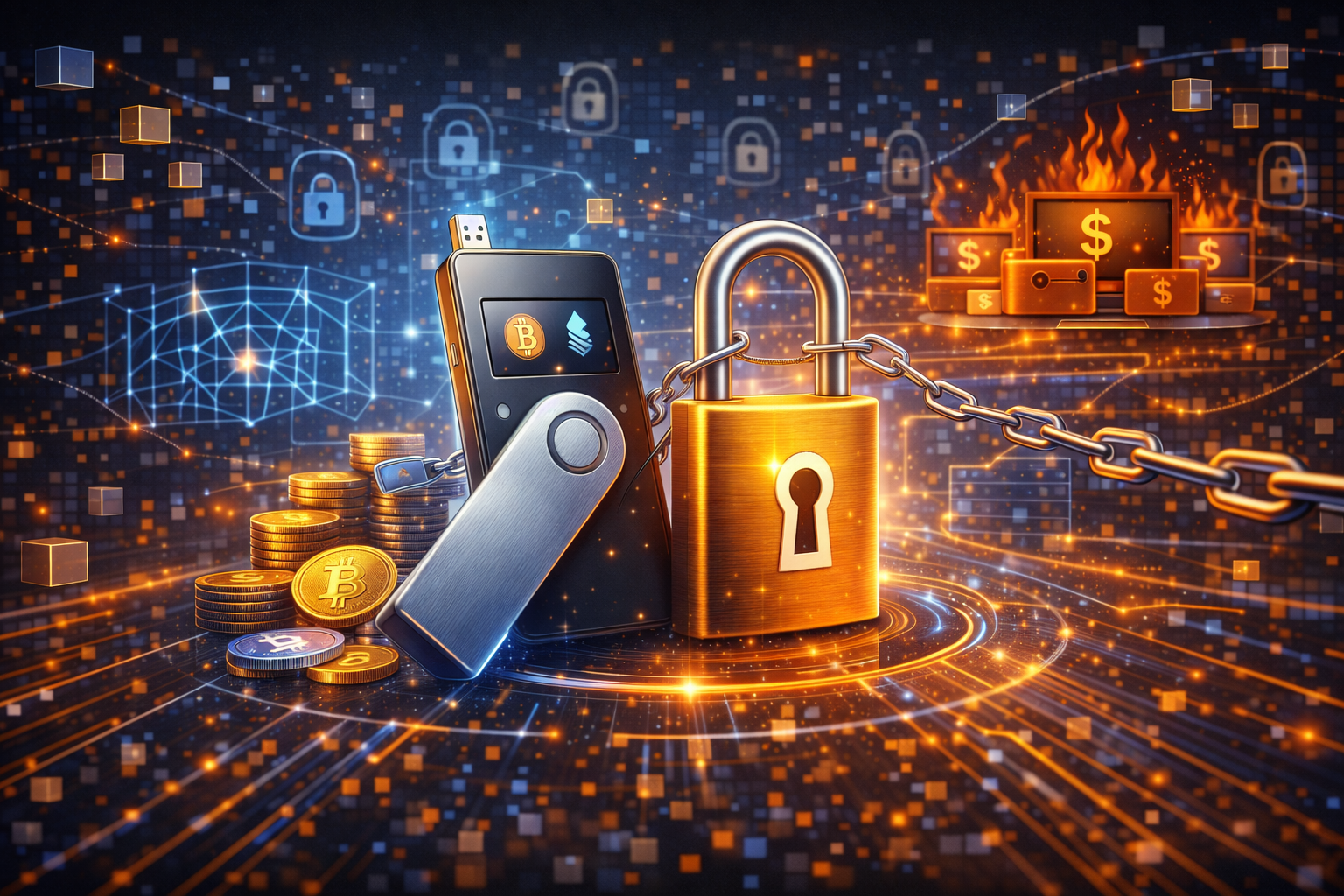
"Not your keys, not your coins"
Hardly any principle shapes the crypto world as strongly as this one:
Whoever does not control the private keys does not control the assets.
After multiple exchange insolvencies, custody failures, and regulatory interventions, self-custody has evolved from an ideology into a risk management necessity.
Hardware wallets are at the center of this development. They form the safest bridge between digital ownership and physical control.
From an AI-analytical perspective, it is clear:
Self-custody will not be optional in the coming market cycle – it will be standard.
Why Self-Custody Is Back in Focus
Several structural events have shaken trust in central custodians:
- Exchange insolvencies
- Freezing of customer funds
- Regulatory access possibilities
- Custodial hacks
- Platform mismanagement
These risks exist independently of market cycles.
Self-custody eliminates counterparty risk entirely – provided the keys are stored securely.
What Hardware Wallets Technically Achieve
Hardware wallets are physical security devices that generate and store private keys offline.
Core functions:
- Offline key storage (cold storage)
- Transaction signing in the device
- Malware isolation
- Physical confirmation requirement
Even on compromised computers, assets remain protected because keys never leave the device.
Security Architecture: Why "Cold" Is Decisive
Software wallets are permanently connected to the internet.
Attack vectors:
- Keyloggers
- Clipboard hijackers
- Remote access malware
- Phishing signatures
Hardware wallets isolate keys completely.
Signature process:
- Transaction is prepared
- Device displays details
- User confirms physically
- Signature occurs offline
This makes remote theft nearly impossible.
BitBox in Focus: Swiss Security Approach
The BitBox02 hardware wallet from Swiss manufacturer Shift Crypto deserves special attention.
It combines minimalist design with high-grade security architecture.
Security Features
- Secure chip
- Open-source firmware
- Verifiable boot process
- MicroSD backup system
- Touch sensor confirmation
Unlike seed-phrase-only systems, the MicroSD backup enables simplified recovery without manual seed entry.
Editions
- Multi Edition – Supports multiple assets
- Bitcoin-only Edition – Maximum security reduction
The Bitcoin-only variant minimizes attack surface through reduced codebase.
Affiliate Link (Partner Integration)
For users considering BitBox:
User-Friendliness as a Security Factor
Security often fails not due to cryptography, but due to UX.
BitBox addresses this through:
- Simple desktop app
- Clear transaction display
- Minimalist operating logic
- Quick backups
User error – the largest cause of loss – is thus reduced.
Ledger & Alternatives in Market Comparison
Besides BitBox, several other established hardware wallet providers exist.
Ledger
Market leader in the hardware segment with broad asset support.
Strengths:
- Secure element chips
- Bluetooth (Nano X)
- Ledger Live software
- Large token compatibility
Criticisms:
- Proprietary firmware components
- Data breach history in e-commerce
Trezor
Pioneer in the hardware wallet sector.
Features:
- Completely open source
- Broad software compatibility
- Strong community auditing
Other Providers
- Keystone
- Coldcard (Bitcoin focus)
- SafePal
Each provider balances security, UX, and asset support differently.
Bitcoin-Only vs. Multi-Asset Wallets
A growing trend is specialization in Bitcoin-only devices.
Advantages:
- Smaller codebase
- Fewer exploit vectors
- Clear security architecture
Multi-asset wallets, in contrast, offer:
- Portfolio flexibility
- DeFi integration
- NFT support
The choice depends on user profile.
Hardware Wallets & DeFi
Modern hardware wallets increasingly integrate into Web3 infrastructure.
Applications:
- DeFi swaps
- Staking
- NFT signatures
- DAO governance
Integration occurs via:
- Browser wallet bridges
- WalletConnect
- Native apps
This keeps self-custody intact even in complex on-chain environments.
Recovery & Backup: Critical Security Layer
The greatest risk factor remains the user themselves.
Important principles:
- Store seed phrase offline
- No cloud storage
- Use metal backups
- Geographic redundancy
Device loss is irrelevant – seed loss is fatal.
Institutional Self-Custody
Not only retail, but also institutions increasingly rely on hardware security models.
Structures include:
- Multisig treasuries
- Hardware key sharding
- MPC + hardware hybrid models
Self-custody is evolving into an institutional security norm.
Regulatory Dimension
With growing regulation, the importance of private custody increases.
Reasons:
- Access protection
- Capital flow independence
- Financial self-determination
Hardware wallets function as the last line of defense against systemic access possibilities.
AI Perspective: Self-Custody as Infrastructure Layer
From a systemic viewpoint, hardware wallets are more than devices – they are ownership infrastructure.
They secure:
- Private property rights
- Digital identities
- Tokenized real-world assets
- DAO governance shares
The more assets become tokenized, the more critical key control becomes.
Future Outlook
The next generation of hardware wallets will expand to include:
- Biometric signatures
- Secure enclave smartphones
- Social recovery models
- ZK key sharding
Self-custody will become more user-friendly – without security loss.
Conclusion: Ownership Means Control
Crypto was created to digitize ownership – not to recentralize it.
Hardware wallets embody this principle technically.
From an AI-analytical perspective, the conclusion is:
Exchanges are trading venues.
Hardware wallets are ownership storage.
With growing adoption, regulation, and capital inflows, self-custody becomes a core competency for every market participant.
And hardware wallets remain its safest foundation.